


EXECUTIVE CONTROL
Your numbers can be strong.
And still leave you exposed.
Before you change the business, understand what is actually producing its performance.
Revenue. Margin. EBITDA. Growth.
You know the results.
But do you know what is producing them?
What does the business have to absorb to keep delivering?
Where are people compensating for what the organisation cannot?
Where are suppliers, interfaces or dependencies carrying performance that leadership does not see?
The organisation you govern
is not always the system that produces your performance.
If leadership governs A and measures C, how much of B can it actually see?
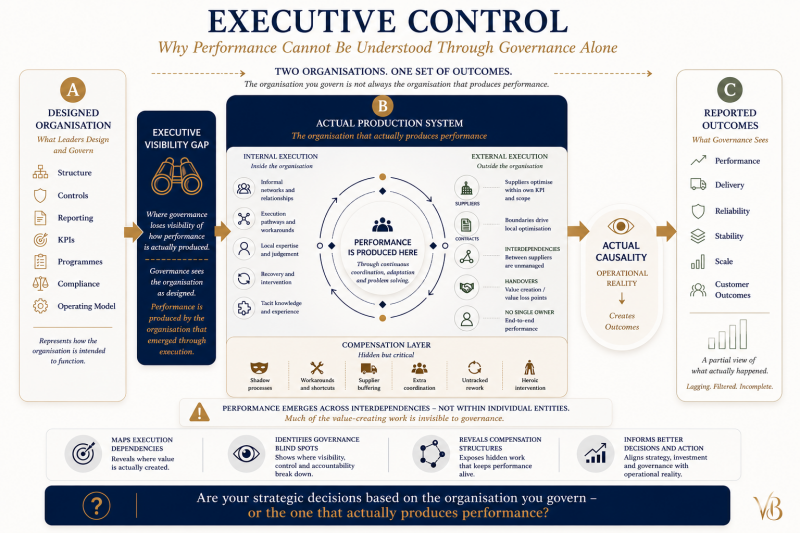
The numbers won't tell you. Change does.

What your numbers don't show
Revenue grows.
Is the business growing because it can do more, or because people are doing more than the organisation can support?
Margin improves.
Did the business become more efficient, or did the cost of inefficiency simply move somewhere the margin does not see?
EBITDA increases.
Did the business become more capable, or did the organisation become better at compensating for what the business is not capable of?
Independent Executive Assessment
Know what you are changing before you change it.
Executive Control establishes what sits beneath reported performance:
What is actually producing it.
What it depends on.
Where the organisation is compensating.
Where the system may be exposed.
The scope follows the decision.
It may be a business unit, operating model, transformation, end-to-end flow, critical supplier ecosystem or a production system extending beyond organisational boundaries.
Independent. Evidence-based. Focused on the decision ahead.

What change can expose
A business can look capable because people are compensating for what it leaves unresolved.
It can look resilient because managers intervene, suppliers compensate and teams work around constraints that remain unknown.
It can look high-performing because people carry the gaps.
It can look scalable because people absorb complexity the organisation was never designed to handle.
Today's performance does not necessarily tell you what tomorrow's change will expose.
If you are about to:
Scale. Transform. Restructure. Outsource. Acquire. Invest. Change the operating model.
and cannot see what carries the performance:
What will your decisions actually change?
Let's talk
If you have a significant decision ahead and need to understand what sits beneath the performance you depend on, let's talk about what the decision requires you to know.
Confidential, Independent. No obligation.