


THE PRODUCTION SYSTEM
Performance crosses organisational boundaries. Governance usually does not.
The organisation you govern is not necessarily the system producing its performance.
A business may depend on capabilities, decisions, relationships and resources distributed across functions, business units, technology platforms, partners and suppliers.
Together, these elements determine what the business can deliver, how reliably it can deliver it and under what conditions.
Yet responsibility, reporting and control are usually organised around individual functions, organisations and contractual boundaries.
The performance executives see often depends on a system they do not fully see.
THE SYSTEM BEHIND RESULTS
Organisation charts describe formal responsibilities.
Contracts define obligations.
Performance reports measure agreed outcomes.
None necessarily reveals how the different parts work together to produce the result.
The Actual Production System is the combination of capabilities, dependencies and interactions through which performance is produced.
It includes the formally designed and governed organisation, as well as the coordination, interventions, workarounds and trade-offs required to make the system work in practice.
When these dependencies extend beyond the organisation to suppliers and other external parties, the Actual Production System becomes the Shared Production System.
These arrangements may be precisely what enables the business to perform.
Executive Control makes this system visible where it matters to a consequential business decision.
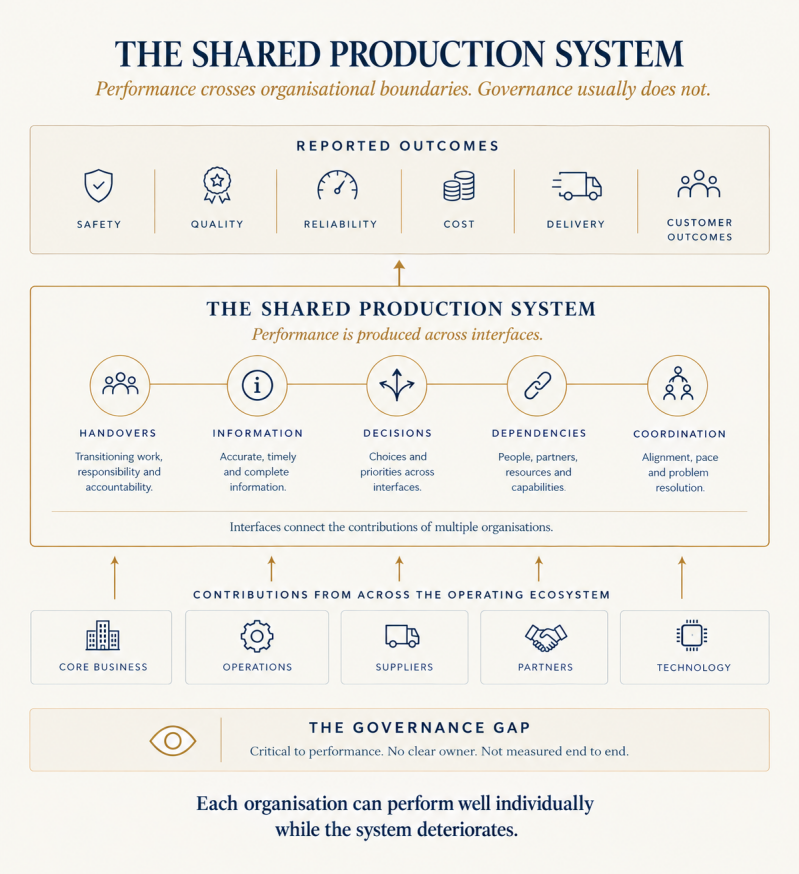
EVERY PART CAN PERFORM, YET THE SYSTEM CAN BE EXPOSED
Each organisation may meet its obligations.
Each function may achieve its targets.
Each supplier may deliver against its contract.
And yet the combined system may depend on fragile interfaces, individual knowledge, informal coordination or unresolved constraints.
No single participant necessarily sees the whole picture. No individual performance measure necessarily reveals the condition of the system as a whole.
Local performance does not, by itself, demonstrate system wide control.
This matters when a business changes through growth, acquisition, outsourcing, digitalisation, automation or a new operating model.
A decision may alter dependencies, remove capabilities or introduce demands that the existing system was never designed to absorb.
Reported performance can remain strong even as the conditions sustaining it deteriorate.
WHAT DETERMINES SYSTEM PERFORMANCE?
Understanding the Shared Production System means examining more than what the business delivers. It means understanding what enables that delivery and what could compromise it.
-
Capabilities: What the system can demonstrably deliver.
-
Dependencies: What that delivery relies on, within and beyond the organisation.
-
Decisions: How priorities, trade-offs and interventions shape performance across boundaries.
-
Conditions: What enables the system to operate as intended.
-
Constraints: What limits performance, resilience or the ability to change.
The purpose is not to map every interaction or add another layer of reporting.
It is to establish which capabilities, dependencies and conditions matter to performance, and where a consequential decision could demand more than the system has demonstrated it can deliver.
BEFORE THE NEXT CONSEQUENTIAL DECISION
When performance depends on a system that extends beyond the organisation, governing the organisation alone may not be enough.
Growth, acquisition, outsourcing and transformation can change the very conditions on which current performance relies.
The question is not simply whether the business is performing.
It is whether you understand what produces that performance and what your next decision may change.
Executive Control makes the operating reality behind reported performance visible, helping decision-makers understand the system they depend on before they ask it to deliver more.
Executive Control
Evidence for executive judgement.